Hollywood Loaded Up: Why the Biggest VFX Pipelines Are Running Film Through the Gate Again
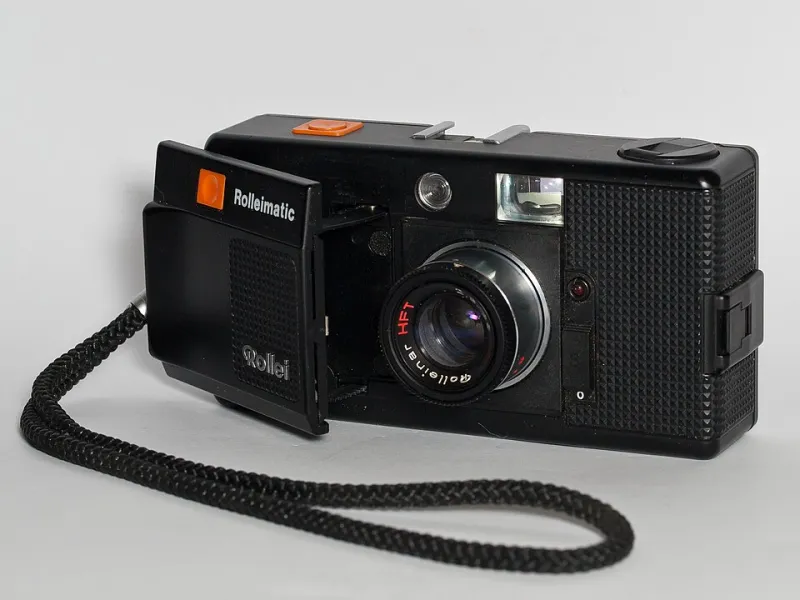
Photo: Uberprutser, CC BY-SA 3.0, via Wikimedia Commons
There's a scene that's been playing out on major film sets across Los Angeles and Atlanta over the last few years that would have seemed almost absurd a decade ago. A visual effects supervisor — someone whose entire career runs on data, render farms, and terabyte drives — walks over to a camera department cart, picks up a 400-foot mag of 35mm film, and nods approvingly. Not because the director is chasing some retro aesthetic. Because film is genuinely the better tool for the job.
Hollywood's relationship with analog has quietly, almost stubbornly, reversed course. And the reasons behind it are more technical than sentimental.
The Digital Promise That Got Complicated
When digital cinema cameras started taking over production in the mid-2000s, the argument was clean and convincing: no film costs, instant playback, flexible ISO, and a pipeline that fed directly into post-production without an intermediate scan. It made sense. Studios saved money. Schedules tightened. Workflows got leaner.
But somewhere along the way, a different set of problems emerged — ones that became especially visible as visual effects work grew more ambitious. Compositing digital footage with CG elements started revealing the hard edges of what sensors capture. Highlight rolloff looked clinical. Grain structures, when added artificially in post, never quite sat right with the image. And certain lighting scenarios — particularly mixed practical and artificial light on location — exposed a kind of sterility in digital capture that compositors had to work overtime to correct.
Film, it turned out, never had those problems to begin with.
What Film Does That Sensors Still Can't Fake
The core issue comes down to how film responds to light versus how a sensor does. A digital sensor captures light in a fundamentally linear way — it measures photons and converts them to data with mathematical precision. Film doesn't work like that. Silver halide crystals respond to light in a way that's inherently nonlinear, especially in the highlights. That gentle, organic rolloff in the brightest parts of a frame isn't a bug — it's a physical property baked into the emulsion.
For VFX pipelines, that rolloff is gold. When you're compositing a CG character into a practical environment, or blending an LED volume background with real foreground elements, film's natural response creates a kind of visual glue. The image already looks like it belongs to itself. Compositors working with film scans frequently note that the work is simply easier — not because the technology is more advanced, but because the starting material behaves more like human vision.
Color science is the other piece. Film stocks have distinct spectral response curves that interact with light in ways no digital color science profile has fully replicated. Cinematographers shooting on stocks like Kodak Vision3 500T aren't just getting a look — they're getting a response to mixed lighting conditions that holds together across a frame in ways that can take significant digital grading work to approximate.
The Directors and DPs Leading the Charge
This isn't a fringe movement. Some of the most commercially successful productions of recent years have made deliberate, documented decisions to incorporate 35mm — sometimes for entire features, sometimes for specific sequences where the visual demands made film the obvious call.
Christopher Nolan has been the most vocal advocate, but he's far from alone. Cinematographers like Linus Sandgren, Rodrigo Prieto, and Ari Wegner have all spoken publicly about the ways film simplifies certain aspects of their work, particularly in high-contrast environments or scenes with complex practical lighting. The conversation in the American Society of Cinematographers has shifted noticeably — film is no longer the sentimental choice. It's increasingly the professional one.
VFX houses in Los Angeles and Vancouver have quietly updated their pipelines to accommodate film scans, and some supervisors have started requesting film capture specifically for sequences where they know the composite work will be heavy. That's a remarkable inversion from where the industry was even ten years ago.
What the Kodak Resurgence Actually Signals
Kodak's film manufacturing operation, which many assumed was on a slow walk toward obsolescence, has been running hard to meet demand. The company has invested in production capacity, and their professional motion picture stocks — particularly the Vision3 line — are being ordered in volumes that reflect genuine production need, not nostalgia.
This matters beyond the industry itself. When a major manufacturer expands capacity to meet professional demand, it stabilizes the entire supply chain. The same emulsions that run through a Hollywood camera also end up in Portra 400 and ColorPlus 200. A healthy professional film market is part of what keeps 35mm accessible and affordable for enthusiast photographers.
The Enthusiast Angle: You Were Right All Along
For anyone who's been shooting film while fielding questions about why they don't just use their phone, the Hollywood resurgence offers a useful counterpoint. The aesthetic qualities that drew you to analog — the tonal range, the grain character, the way highlights breathe instead of clip — are the exact same properties that professional cinematographers and VFX teams are paying serious money to access.
You're not chasing a trend or romanticizing obsolete technology. You're working with a medium that has specific, demonstrable optical properties that even the most sophisticated digital systems haven't fully replaced. The fact that major studios are loading film magazines again is essentially a nine-figure endorsement of that position.
It also reinforces something that analog photographers have understood intuitively for years: constraints produce creativity. Shooting with a finite number of frames, committing to exposure decisions in the moment, trusting the emulsion to do its job — these aren't limitations. They're the conditions under which a certain kind of image becomes possible.
Where This Goes From Here
The honest answer is that nobody knows exactly how this plays out. Digital technology will keep improving, and there are scenarios — particularly low-light work and fast documentary-style shooting — where sensors have genuine advantages that film can't match on practical grounds.
But the conversation has fundamentally changed. Film is no longer the format you choose when you're being precious or nostalgic. It's the format you choose when it's the right tool. That distinction matters, both for how the industry thinks about production and for how enthusiast photographers understand their own practice.
Next time someone asks why you're still shooting on film, you've got a pretty solid answer. Hollywood's best visual effects teams are asking the same question — and coming to the same conclusion you did.