One Lens, One Vision: The Case for Committing to a Single Focal Length
Every photography forum has some version of the same thread. A new shooter asks what lens they should start with. The top answer, reliably, recommends a zoom. Something versatile. A 28-80mm kit lens, maybe, or a 35-70mm that covers the bases. The logic is sound on the surface — try everything, figure out what you like, commit later.
It's also, I'd argue, one of the worst pieces of advice you can give someone learning to see photographically.
Here's the contrarian position: the fastest way to develop a genuine visual voice is to remove your options. Pick one focal length. Shoot it exclusively. Do it for months, maybe years. And watch what happens to the quality of your attention.
The Problem With Versatility
Zoom lenses are a solution to a logistical problem, not a creative one. They exist because working photographers in certain genres — weddings, sports, news — genuinely need the flexibility to respond to unpredictable situations without changing glass. In those contexts, a zoom makes obvious practical sense.
But most of us aren't shooting breaking news. We're making photographs because we want to make photographs. We're trying to develop a way of seeing — a distinctive visual sensibility that makes our work recognizable and meaningful. And for that goal, versatility is actively counterproductive.
When you have a zoom, every scene becomes a negotiation. You stand in front of something interesting and you start turning the ring, testing different framings, trying 35mm then 50mm then 70mm. You're solving a puzzle. And while you're solving that puzzle, you're not doing the harder and more important work of learning to see the world through a specific frame.
A prime focal length eliminates the negotiation. There's only one answer to the framing question: get closer or step back. And in forcing you to physically move rather than optically adjust, it changes your relationship with the scene entirely.
How Constraint Built the Greats
This isn't a new idea. Some of the most recognizable bodies of work in photographic history were produced by photographers who made deliberate, long-term commitments to a single focal length.
Henri Cartier-Bresson shot almost exclusively with a 50mm lens for the majority of his career. His entire compositional language — the geometry, the spatial relationships, the way figures interact with architecture — was built around that specific angle of view. His photographs don't just look like Cartier-Bresson because of his eye. They look like Cartier-Bresson because of his lens. The 50mm perspective is baked into his visual DNA.
Garry Winogrand was a 28mm devotee. That wide, slightly distorted view of the world — the way it pulls you into the scene, the slight exaggeration of near/far relationships — is inseparable from his aesthetic. You can't imagine his New York street work shot at 85mm. It would be a different photographer's work.
William Eggleston, the godfather of American color photography, worked primarily with a 50mm and, later, wide angles. His democratic, un-hierarchical approach to subject matter is visually reinforced by the un-dramatic perspective of a normal lens. The lens choice isn't incidental to the work — it's constitutive of it.
These weren't photographers who tried every focal length and settled on a favorite. They committed early and built entire visual vocabularies around that commitment.
Choosing Your Anchor Lens
So which focal length should you choose? There's no universal right answer, but there are useful frameworks for thinking about it.
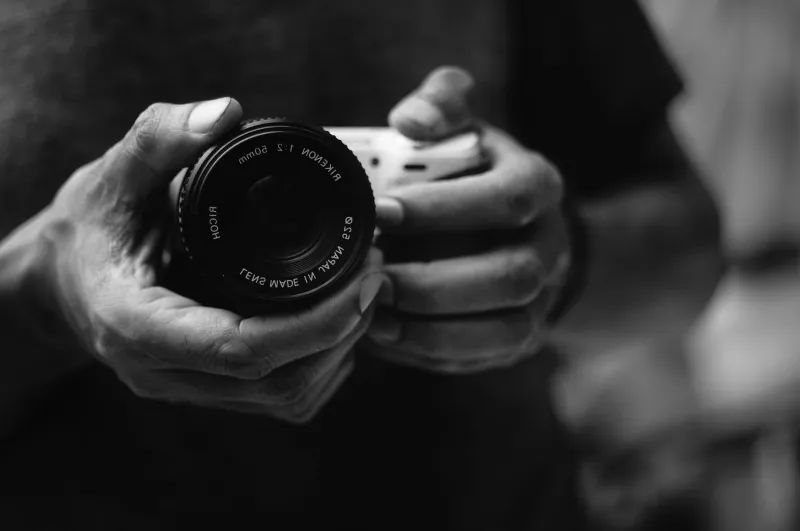
The 50mm (normal lens): The closest approximation to human eye perspective. It's honest, un-dramatic, and deeply versatile across subjects. Because it doesn't exaggerate or compress space the way wider or longer lenses do, it demands that you find interest in the subject itself rather than leaning on optical effects. It's the most demanding and, ultimately, the most educational choice. If you're not sure where to start, start here.
The 35mm: Slightly wider than normal, with just enough angle of view to include environmental context. Excellent for street photography and environmental portraiture. The 35mm is forgiving in tight spaces and produces images that feel immersive without the distortion of a true wide angle. It's probably the most popular choice among contemporary street photographers for good reason.
The 28mm: Genuinely wide. Requires you to get close to your subjects, which changes the psychological dynamic of shooting — especially with people. The 28mm rewards boldness and punishes timidity. If you want a lens that forces you to commit physically to your scenes, this is it.
The 85mm: On the longer end for a street or documentary prime, but exceptional for portraits and detail work. The slight compression of an 85mm is flattering on faces and creates a natural separation between subject and background that's hard to achieve with wider glass. If portraiture is your primary interest, this is worth serious consideration.
A practical approach: think about the photographs you're most drawn to — not your own work, but the work you admire most. What's the perspective? Does it feel wide and immersive or slightly compressed and selective? That instinctive preference is telling you something about your natural visual sensibility. Trust it.
The Discipline in Practice
Choosing your anchor lens is the easy part. The discipline is in actually using nothing else, and that's where most people abandon the experiment too early.
You'll have moments where you see something and immediately think if only I had a longer lens or I wish I had something wider right now. That frustration is the point. It's forcing you to solve a problem — how do I make a compelling image with what I have? — and the solutions you find will become the building blocks of your visual style.
Set a concrete timeline. Three months minimum. Six is better. Shoot every roll with the same lens on the same camera. Fill notebooks if that's your thing, or just pay attention to what's working and what isn't. By the end, you won't just know your focal length. You'll know how you see.
The Gear Collector Trap
There's one more thing worth naming directly: the photography internet has a gear acquisition problem, and the recommendation to start with a versatile zoom often accelerates it. You buy the zoom, you decide you need more reach, you add a telephoto, then a wide angle, and suddenly you're carrying a bag full of glass and spending more time thinking about equipment than making photographs.
One camera. One lens. One roll at a time.
That's the whole philosophy of 35mm film photography distilled to its purest form. The gear serves the vision, not the other way around. And the vision develops when you stop giving yourself options and start learning to see.
Commit to a focal length. Shoot it until it becomes an extension of how you think. Then — and only then — consider whether you actually need anything else.
You might be surprised by the answer.