Dark by Design: Inside the DIY Lab Collectives Keeping Film Alive in America
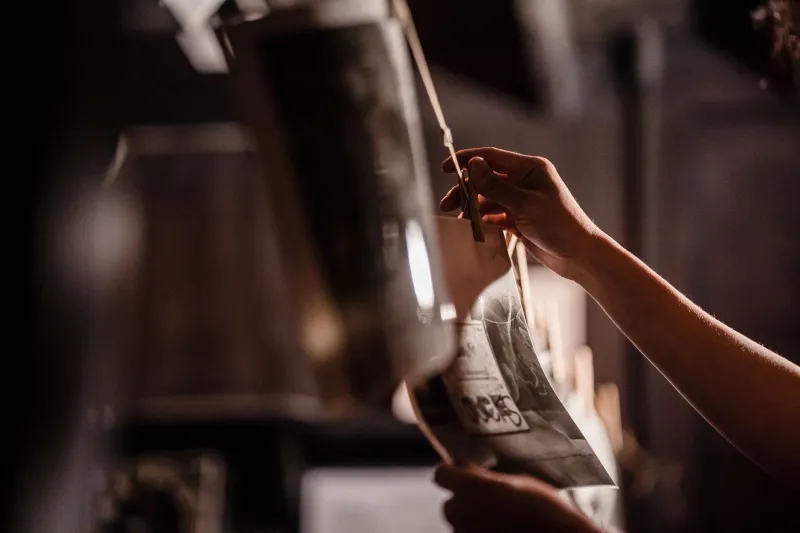
On a Tuesday evening in a converted warehouse space in East Austin, six people are crowded around a sink in near-total darkness. Someone's counting seconds out loud. Someone else is quietly arguing about developer temperature. There's the rhythmic sound of a tank being agitated, and underneath all of it, a low hum of conversation about a photo essay someone's been working on for three months.
This is not a commercial photo lab. There's no counter, no ticket system, no two-day turnaround promise. This is a community darkroom — part lab, part classroom, part gathering place — and it's part of a movement that's quietly reshaping what analog photography looks like in America.
The Gap That Created the Movement
To understand why community film labs exist, you have to understand what disappeared. Through the 2000s and into the 2010s, the commercial film processing infrastructure that once blanketed American cities — the one-hour labs, the dedicated camera stores with in-house darkrooms, the department store photo counters — collapsed almost entirely. Digital photography didn't just change consumer behavior. It wiped out a physical network that film photographers had relied on for decades.
What replaced it was a handful of mail-in labs serving a national market, a few surviving specialty shops in major cities, and a long wait for anyone who didn't live near one of those nodes. The infrastructure gap was real, and it hit newer film photographers especially hard. Learning darkroom technique requires access to a darkroom. When commercial labs stopped offering community access, that path closed for a lot of people.
The community lab movement is, at its core, a response to that gap. People got tired of waiting for someone else to fix the infrastructure and started building it themselves.
What These Spaces Actually Look Like
No two community darkrooms are identical, but a few models have emerged as the most common.
The membership collective operates like a co-op. Members pay monthly dues — typically somewhere between $40 and $120 depending on the city and the facilities — in exchange for access to shared equipment, darkroom time, and often a chemicals program that handles bulk purchasing. The Darkroom Collective in Chicago and Photoworks in San Francisco both operate on roughly this model, with tiered membership structures that try to make access financially realistic for students and lower-income members.
The hybrid lab-studio combines a working commercial lab (offering development and scanning services to the public) with a membership or workshop component. Revenue from commercial services subsidizes the community programming, which makes the model more financially stable than pure collectives. Film Lab LA operates this way, as does the Indie Film Lab in Montgomery, Alabama — which has become something of a national model for combining high-volume mail-in services with local community programming.
The artist-run space is often the most informal and the most culturally interesting. These emerge from existing artist collectives, photography MFAs, or just a group of dedicated shooters who pooled resources to rent a space. They're sometimes chaotic, occasionally financially precarious, and frequently the places where the most interesting work is being made. Several have emerged from the network of maker spaces and DIY venues that exist in most mid-sized American cities.
The Economics of Running a Darkroom in 2024
Let's be honest about something: this is not an easy business to run. Chemistry costs have increased significantly. Darkroom equipment — enlargers, tanks, timers, safelights — is mostly vintage and requires ongoing maintenance. Ventilation systems that meet code are expensive to install. And the audience, while passionate, is not large.
The collectives that are surviving have figured out a few things that the ones that have closed often didn't.
Workshops are the revenue engine. A two-hour introduction to black and white darkroom printing, priced at $65-$85 per person and run twice a month, generates more reliable income than membership dues alone. Workshops also serve as the primary pipeline for new members — people show up for a class, fall in love with the process, and convert to members. The Analog Photography Club in Denver has built almost its entire growth strategy around this model.
Partnerships with schools and universities matter. Several community labs have formalized relationships with local art schools and community colleges, providing darkroom access for students whose institutions have downsized or eliminated their own facilities. These institutional partnerships provide both revenue and a steady stream of engaged young photographers.
The community IS the product. The labs that position themselves purely as service providers — a cheaper alternative to commercial processing — struggle. The ones that understand they're selling access to a community, a culture, and a practice tend to build the loyalty that sustains them through difficult periods.
Darkroom Access as a Political Act
Something worth sitting with: for a lot of the people running these spaces, this isn't just about photography. It's about who gets to participate in creative culture.
Historically, darkroom access required either institutional affiliation (art school, a well-funded university program) or significant personal resources. The analog revival of the last decade has sometimes reproduced those barriers — the cost of film, the cost of cameras, the cost of processing can add up fast, and the aesthetic culture around film photography has occasionally skewed toward a certain kind of affluent nostalgia.
Community labs are, at their best, a direct challenge to that dynamic. Sliding-scale memberships, free community nights, partnerships with youth photography programs, film donation drives — these are the tools collectives use to make the darkroom genuinely accessible rather than aspirationally so.
"We talk about this explicitly," says one of the organizers of a collective in Philadelphia that asked not to be named while their nonprofit status is pending. "Who gets to make photographs? Who gets to learn this craft? Those aren't abstract questions. They're about what spaces exist and who can afford to walk through the door."
What Gets Made in These Spaces
Beyond the organizational politics and the business models, there's the work itself. And the work coming out of community darkrooms is genuinely interesting.
Because these spaces attract photographers at all levels — from people shooting their first roll to seasoned practitioners who've been developing for thirty years — there's a cross-pollination of approaches and aesthetics that doesn't happen when everyone's mailing their film to the same lab and editing their scans alone at home. Someone's printing documentary photographs of their neighborhood next to someone making abstract darkroom experiments next to someone learning to process their first roll of HP5. That proximity produces conversations, and those conversations produce photographs that might not have existed otherwise.
The community lab isn't a replacement for the commercial infrastructure that disappeared. It's something different — messier, more personal, more explicitly about the practice of photography as a shared activity rather than a solitary technical process.
Which, if you think about it, is exactly what 35mm film has always been about. You don't shoot a roll in isolation. You shoot it in a world, among people, in response to light and time and presence. Processing it together just makes that truth a little more visible.