Two Stops Past Sanity: Inside the Push-Processing Underground
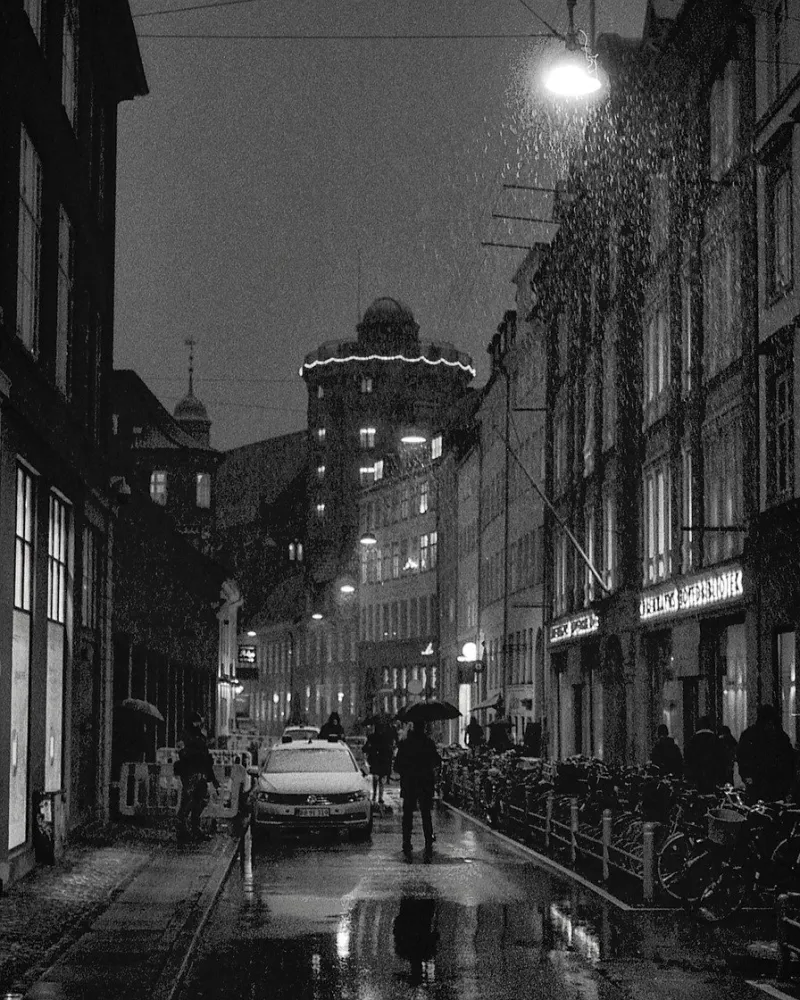
Photo: high contrast black and white 35mm film night street photography grain, via images.squarespace-cdn.com
Somewhere in your city right now, a photographer is loading a roll of Ilford HP5, setting the camera to ISO 3200, and telling the meter to go to hell. They're going to shoot a dim bar, a subway platform, a rain-slicked alley at 1 a.m. — and when the roll comes back, it's going to look like a crime scene photo from the best possible movie.
This is push processing, and it's having a moment.
The Mechanics, Minus the Lecture
The idea is simple. Film is rated at a certain sensitivity — say, ISO 400. If you rate it higher in your camera (shooting it 'at 1600'), you're underexposing every frame. Push processing compensates in development: extended time or agitation in the developer lets the thin negatives build back contrast and density.
The result isn't a free lunch. It's a trade:
- You lose shadow detail. Underexposed shadows go thin, and pushing doesn't fully bring them back. Blacks get crushed. Embrace it.
- Grain explodes. Not uniformly — it clusters in the midtones and mid-shadows, giving pushed Tri-X that famous 'documentary of a panic attack' texture.
- Contrast gets violent. Highlights stay relatively bright while shadows drop. Streetlights bloom. Faces emerge from darkness like witnesses.
One stop of push is subtle. Two stops is a look. Three or four stops is a commitment to a lifestyle, and honestly, that's where the fun starts.
The Lab Problem
Here's the part nobody warns you about: labs hate pushing. Not all of them — but many one-hour labs either don't offer push processing, charge a premium, or quietly 'correct' your roll back to box speed, which flattens everything you did.
Before you shoot a pushed roll, call your lab. Ask specifically: 'Do you develop at pushed speeds, and do you charge extra?' A real answer takes ten seconds. If they hesitate, find another lab or develop it yourself.
The DIY Route
Pushing at home is one of the easiest doors into self-development, because the math is forgiving and the equipment list is short: a tank, a reel, a thermometer, and a developer that handles push well. Options like Kodak D-76, Ilfotec DD-X, and Rodinal all have published push times — DD-X in particular is beloved for keeping HP5's shadows from collapsing entirely at 1600.
Start with two stops. Extend your development time per the chart, keep your temperature honest, and agitate consistently. Your first roll will have flaws. Your third roll will look intentional. That's the whole learning curve.
Why Ditch Digital High ISO
Modern mirrorless cameras shoot clean files at ISO 12800. So why push film at all? Because 'clean' was never the point.
Pushed black-and-white film doesn't just capture a dark scene — it interprets it. The grain and contrast add the tension and texture that noise reduction sands away. Night shooters describe it as the difference between seeing a memory and watching a monitor. Digital high ISO documents the dark. Pushed HP5 dramatizes it.
There's also a discipline angle, which Shoot35 readers will recognize: when you're at 1600 with a shutter you can't safely hand-hold below, every frame is a decision. You don't spray. You hunt.
A Warning Worth Heeding
Push the whole roll or don't push at all — exposure rating is baked in frame by frame, but development isn't. And know your stock: HP5 and Tri-X are legendary pushers; some slower, finer-grained films turn into contrast monsters well before 1600. Slide film, don't even ask.
Load the roll. Rate it high. Shoot the dark. The shadows were never empty anyway.