Main Street Still Sells Film: A Cross-Country Tour of America's Last Analog Outposts
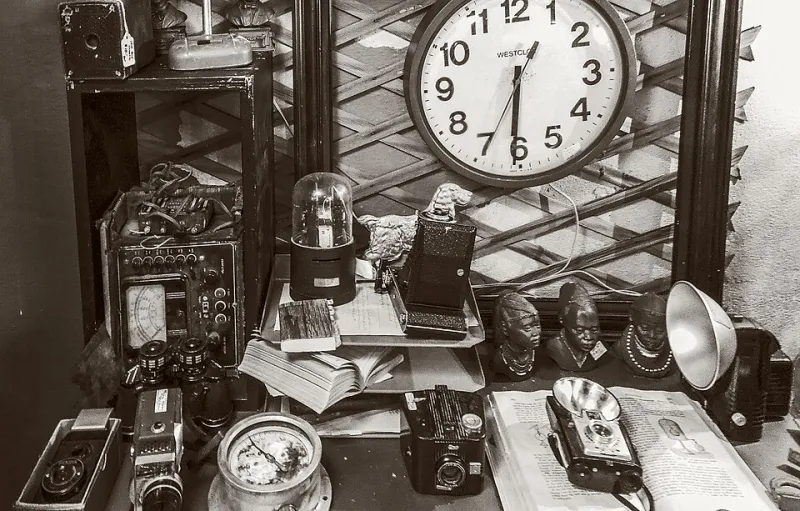
Photo: G. Lamar, CC BY 2.0, via Wikimedia Commons
There's a moment that happens in every good camera store. You pick something up. The shutter fires. Somebody behind the counter says, 'Careful, that one's a grump about batteries,' and just like that, you're in a conversation no website has ever had with you.
We spent three weeks driving across the country to find out who's still having those conversations. Not the big-city flagships everyone knows — the survivors. The independents. The shops that watched e-commerce eat their industry and decided to stick around anyway.
Pasadena: Where the Counter Knows Your Name
Start in Southern California, because that's where the density is. A shop a few blocks off the 110 has been selling film cameras since before the internet was a household word. The owner, who bought the business from his mentor a decade ago, describes the last five years in one word: 'absurd.'
'In 2012 I was selling bodies for forty bucks to clear shelf space,' he told us, gesturing at a glass case where similar cameras now sit with price tags in the hundreds. 'Now I get calls from kids asking if we have "the TikTok one." I tell them the TikTok one is over there, and the better one is right here for a third of the price.'
That's the pitch you can't get online: the correction. The hand on your shoulder that steers you away from the hype and toward the camera you'll actually shoot.
The Nebraska Detour
Then there's the other end of the scale. A small town of a few thousand people, one main street, and a camera shop that's been there since the Nixon administration. The owner stocks maybe a dozen rolls of film — Portra, UltraMax, whatever her distributor can actually get — and she sells every roll.
'I'm not a destination store,' she laughs. 'I'm a convenience. The nearest lab is ninety minutes away. If I closed, these folks would be mailing their film to New Jersey.'
Her regulars include a high school photography club that fundraises for film, a retired mail carrier shooting his third decade of one-frame-per-day projects, and farmers who bring in weathered Box Brownies found in attics. The economics are thin. She keeps the doors open partly with repair work — 'everyone's grandfather has a dead Canonet in a drawer' — and partly, she admits, with stubbornness.
How They're Actually Surviving
Talking to owners across a dozen states, the survival playbook looks surprisingly consistent:
- Services over boxes. Film developing, scanning, and repair now outearn camera sales at most of the shops we visited. A roll of Portra 400 is a commodity online. Trusting someone with your only negatives from a wedding is not.
- Community as infrastructure. Workshops, photo walks, loaner cameras for students. Every owner described this as marketing; none of them described it as a money-loser.
- Curated inventory, not deep inventory. Nobody tries to stock everything. They stock what they can stand behind and order the rest.
One Chicago shop owner put it bluntly: 'Amazon killed the camera superstore. It can't kill a guy who fixes your Nikon while you wait and tells you which film stock won't hate winter.'
Why It Still Matters
You can buy a camera online for less. Everyone knows that. But film photography has always been a tactile hobby, and there's a real cost to buying blind: dead meters, fogged seals, shutters that sound fine and aren't. Every shop owner we met had a story about a mail-order disaster walked in off the street, hoping for a rescue.
More than that, these stores are the hobby's memory. They're where a sixteen-year-old learns what a light meter sounds like, where a widow brings her husband's Leica to find out what it's worth and leaves with it serviced instead of sold.
The shops are fewer than they were — nobody's pretending otherwise. But the ones left aren't museums. They're busy, loud, and, in their own quiet way, essential. Go put a camera in your hands before you buy it. Somebody behind a counter is waiting to tell you it's a grump about batteries.
If there's a surviving analog shop in your town, tell us about it in the comments — we're keeping a running map.