When Film Breaks Its Own Rules: Turning Reciprocity Failure Into Your Secret Weapon
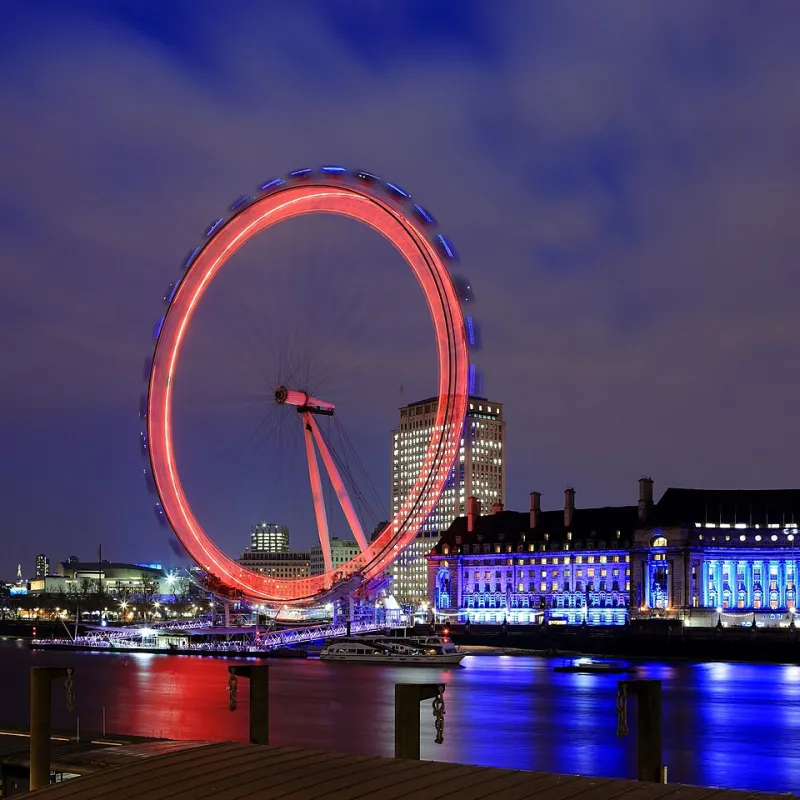
Photo: Martin Falbisoner, CC BY-SA 3.0, via Wikimedia Commons
There's a moment every analog photographer eventually hits. You've set up a long exposure — maybe a star trail over the Mojave, maybe a rain-slicked street in Chicago at 2 a.m. — and you've done the math. Aperture, ISO, shutter speed. Textbook stuff. But when you pull the developed frame from the sleeve, something is off. The shadows are denser than they should be. The colors have shifted somewhere unexpected — a green cast where there should be neutral gray, or a deep magenta bloom across the highlights. The image looks nothing like what the meter promised.
Welcome to reciprocity failure. And if you've been running from it, it might be time to stop.
So What Is Actually Happening?
At normal shutter speeds — say, 1/60th to 1/1000th of a second — film behaves predictably. Double the light, double the exposure. That relationship is called the reciprocity law, and it holds up beautifully in daylight or under studio strobes. But push your exposure into the multi-second or multi-minute range, and film starts doing its own thing.
The technical explanation has to do with how silver halide crystals in the emulsion respond to low-intensity light over extended time. Individual photons hit the crystals, but at a slow enough rate that some of the latent image formation actually reverses before development — a process called the Schwarzschild effect. The result: your film effectively becomes less sensitive the longer you expose it, meaning you need even more time than the math suggests. And different emulsion layers within color film can drift at different rates, which is where those wild color shifts come from.
Every film stock handles this differently. Kodak Portra 400 is relatively forgiving — it needs some compensation at long exposures, but it stays composed. Fuji Velvia 50, on the other hand, goes full impressionist on you past 1 second, developing a strong green-to-cyan push that's become something of a signature look in landscape film photography. Ilford Delta 3200 in black and white? Expect significant shadow blocking and a contrast curve that seems to have opinions of its own.
The Community Started Treating It Like a Feature
For most of photography's analog era, reciprocity failure was listed in the back pages of film datasheets with correction tables and apologies. You were supposed to compensate for it — add extra time, bracket aggressively, hope for the best. But somewhere in the last several years, a subset of the analog community started asking a different question: what if we just let it happen?
Shooters posting long-exposure work on forums and film-focused Instagram accounts began sharing frames where the reciprocity drift was obviously present — and obviously intentional. Night sky shots where the deep blue of the sky had twisted toward violet. Urban architecture captured on slide film where tungsten street lights bled into warm amber halos against unnaturally cool building faces. Seascapes where the water had gone silky and the horizon had developed a color temperature that existed nowhere in reality.
The response from the community wasn't "fix your exposure." It was "what film were you using?"
Practical Ways to Put This to Work
If you want to start experimenting deliberately, the approach is actually pretty simple — which is part of the appeal.
Pick your emulsion with intention. Slide films (E-6 process) like Velvia or Provia tend to show the most dramatic color shifts because each dye layer drifts independently. Color negative films like Portra or Kodak Gold are more stable but still show character past 10 seconds. Black and white films like Kodak T-Max 100 or Ilford FP4 give you contrast and shadow compression rather than color drama — a totally different but equally compelling result.
Let your exposures go long — really long. Reciprocity effects become meaningful around 1–4 seconds and grow more pronounced the further you push. For night sky work, exposures of 30 seconds to several minutes will give you the most visible drift. Don't compensate fully. Compensate partially, or not at all, and see what the film gives you.
Shoot at blue hour and into full dark. The transition period between dusk and night is where reciprocity failure and natural light create the most interesting collisions. Your sky might retain ambient color while your shadows go unpredictable. That tension is where the magic tends to live.
Bracket your time, not just your aperture. Instead of shooting one frame at your calculated exposure, shoot three — your calculated time, half that, and double that. You're not just hedging against error; you're giving yourself three different versions of the film's character to choose from on the light table.
Keep notes. This sounds obvious, but it matters more here than almost anywhere else in analog shooting. Reciprocity behavior varies by film batch, by temperature, and even by how long the film has been sitting in your freezer. A notebook with film stock, exposure time, temperature, and result is worth more than any chart you'll find online.
The Part Digital Can't Touch
Here's the honest appeal of all this: digital sensors don't do it. Long-exposure digital images get noisier, sure, and you might get some hot pixels or banding in extreme cases. But there's no drift. No color layer independence. No shadow compression that comes from the physics of photochemistry under stress. The effect is fundamentally tied to the material nature of film — it's not a filter, not a preset, not a simulation. It happened in your camera, on a specific piece of emulsion, at a specific moment.
That's what makes reciprocity failure interesting to shoot and interesting to look at. The image carries evidence of its own making. You can see the film thinking.
Start Ugly, Finish Curious
The first time you deliberately shoot for reciprocity failure, you might hate the result. The exposure will be wrong in ways you didn't plan for, the colors will be somewhere you didn't expect, and you'll have spent a roll of film and probably a tripod-heavy hour getting there. That's fine. That's the process.
The second time, you'll start to understand what a particular film does. The third time, you'll start to predict it. And at some point, you'll pull a frame from a sleeve and realize you made something that couldn't have been made any other way — not with a phone, not with a mirrorless, not with any amount of post-processing. Just a camera, a roll of film, a long exposure, and a chemical process that refused to behave.
That's the whole deal with shooting on film, isn't it? The frame surprises you. Reciprocity failure just turns up the volume.