Score Big, Not Burned: The Smart Shooter's Playbook for Hunting Used Film Cameras
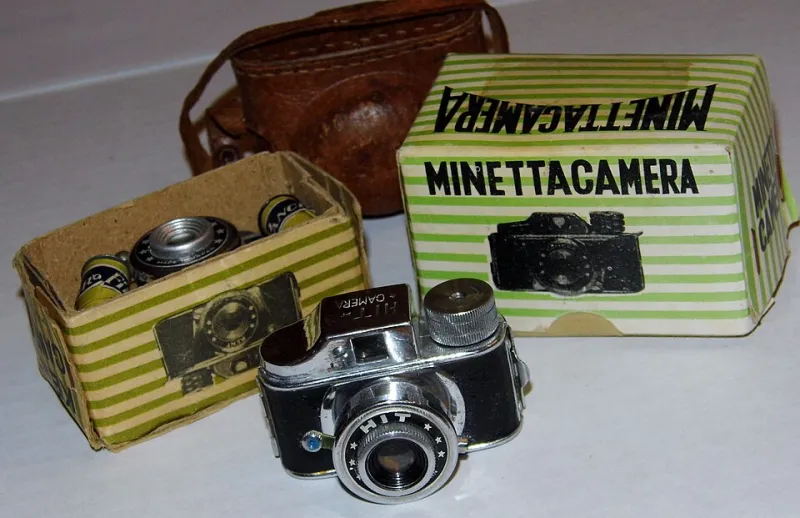
Photo: Joe Haupt from USA, CC BY-SA 2.0, via Wikimedia Commons
There's a particular kind of rush that comes with spotting a clean Olympus OM-1 buried under a pile of old Reader's Digests at a flea market. Your pulse ticks up. You play it cool. You pick it up like you're mildly curious. That little performance? That's part of the game — and if you're serious about building a film kit without wrecking your wallet, learning to play it well matters.
The secondhand camera market in the US is thriving right now, which is both great and complicated. More people want vintage gear than ever, which means prices have crept up, fakes and "as-is" traps have multiplied, and the casual seller who used to let a Canonet go for $8 has now watched three YouTube videos and priced it at $180. But deals still exist. You just need to know where to look, what to look for, and when to walk away.
Where the Real Finds Actually Live
Estate sales remain the holy grail for analog hunters. Unlike flea markets, where resellers have already cherry-picked the good stuff, estate sales sometimes move gear before it ever hits the secondary market. Apps like EstateSales.net and Estatesales.org let you filter by location and browse photos ahead of time — and yes, it's worth waking up early on a Saturday. The first hour matters.
Thrift stores are hit or miss, but chains like Goodwill and Savers occasionally surface film cameras, especially in suburban locations near retirement communities. Don't overlook church rummage sales or neighborhood Facebook groups either. Those channels are slow and require patience, but the sellers usually aren't pricing to the market.
Online, the landscape is more competitive. eBay is the default, but prices there often reflect what sellers wish they could get, not what's fair. For more grounded deals, check out:
- Facebook Marketplace — great for local pickups, often negotiable
- Craigslist — still alive, especially in mid-size cities
- r/photomarket on Reddit — a solid community with reputation-based selling
- KEH Camera — not cheap, but graded honestly and trustworthy
- Bellamy Hunt's Japan Camera Hunter — for more exotic or Japanese-market gear
Red Flags You Should Never Ignore
Let's talk about the stuff that'll cost you if you skip it. Whether you're holding a camera at a swap meet or squinting at listing photos on your phone, these warning signs should give you pause:
"Works great, sold as-is." These two phrases in the same sentence are contradictory on purpose. It usually means the seller isn't confident the camera actually functions. Always ask for a functional demo or, at minimum, recent test shots.
Foam light seals that look like black crumbles. That dusty black foam around the film door? It degrades over decades and will absolutely ruin your rolls if it's not replaced. It's a cheap fix, but factor it into your offer.
Hazy or fungus-spotted lenses. Tilt the lens toward a light source and look through it. Fungus looks like spider webs; haze looks like fog. Mild haze can sometimes be cleaned, but fungus that's etched the glass is permanent.
Sticky or sluggish shutters. On cameras with cloth focal-plane shutters — like the Pentax Spotmatic or Nikon F2 — oil migration over time causes the shutter curtains to slow down or stick. This leads to overexposed frames. Fire the shutter at different speeds and listen. It should sound crisp and consistent.
Inflated pricing based on "vintage" alone. A camera being old doesn't make it valuable. A Kodak Instamatic from 1972 is not worth $60 just because it's retro. Cross-reference prices on eBay's sold listings — not active ones — to see what gear actually clears.
Negotiating Without Being Weird About It
Negotiation at estate sales and flea markets is expected. Nobody's offended by a reasonable counter. The key is framing your offer around the camera's condition, not just your budget.
Instead of "Can you do $40?", try: "The shutter feels a little sticky and the foam needs replacing — would you take $40?" You're giving them a reason, not just a number. It works better, and it's honest.
For online deals, offering to pay via Venmo or cash for local pickup (versus PayPal with buyer protection) can sometimes get you a small discount. Just don't give up buyer protection entirely for anything over $50 — that's how people lose money on broken gear.
If you're at an estate sale and something is priced high, ask if there's a discount at the end of the day. Many estate sale companies drop prices 25–50% in the final hours.
Authenticating Vintage Lenses (Because Fakes Exist)
Vintage lenses — especially Leica M-mount glass and certain Canon FD or Nikon AI lenses — have a counterfeiting problem. Re-badged or rehoused lenses get passed off as originals, and at $300+ a pop, that's a real issue.
A few ways to protect yourself:
- Check the serial number. Most major lens manufacturers have serial number databases or community-maintained lists online. A quick Google of "[lens brand] serial number database" usually pulls something up.
- Look at the glass coatings. Authentic vintage Leitz or Zeiss glass has distinctive coating colors when held at an angle — often amber, blue, or purple. Mismatched coatings are suspicious.
- Research the aperture blades. Authentic lenses have a specific number and shape of aperture blades. If a "Summicron" has seven blades instead of eight, something's off.
- Ask the seller provenance questions. Where'd they get it? Do they have original caps or boxes? Legitimate sellers usually have a story. Vague answers deserve more scrutiny.
What Collectors Actually Say About Their Best Finds
We talked to a few members of the Shoot35 community about their most memorable scores.
"I picked up a mint Nikon FM2n at an estate sale in Ohio for $35. The woman running it had no idea what it was. I almost felt bad — then I remembered I'd overpaid on three cameras before that one." — Marcus T., Cleveland
"My rule is never buy a camera I can't test on the spot. I carry a roll of expired film to every swap meet. If the seller won't let me run a frame through it, I don't buy it." — Priya S., Austin
"Reddit's photomarket saved me. Bought a Contax G2 with two lenses from a guy in Portland — he had 200+ verified trades and sent it double-boxed with foam. That's the kind of seller you look for." — David R., Chicago
The Thrill Is Part of the Point
Here's the thing about hunting film cameras: even when you go home empty-handed, it's still kind of a good time. There's a community built around this stuff — the shared language of shutter speeds and frame counts, the mutual respect between people who still choose to shoot on film when literally every other option is easier.
The market's trickier than it used to be, sure. But the deals are still out there. You just have to show up, stay sharp, and know when that $35 FM2n is worth running for — and when that $180 Canonet is a hard pass.
Happy hunting.