Shutter Speed Secrets: How Your Grandfather's Camera Wins the Flash Game
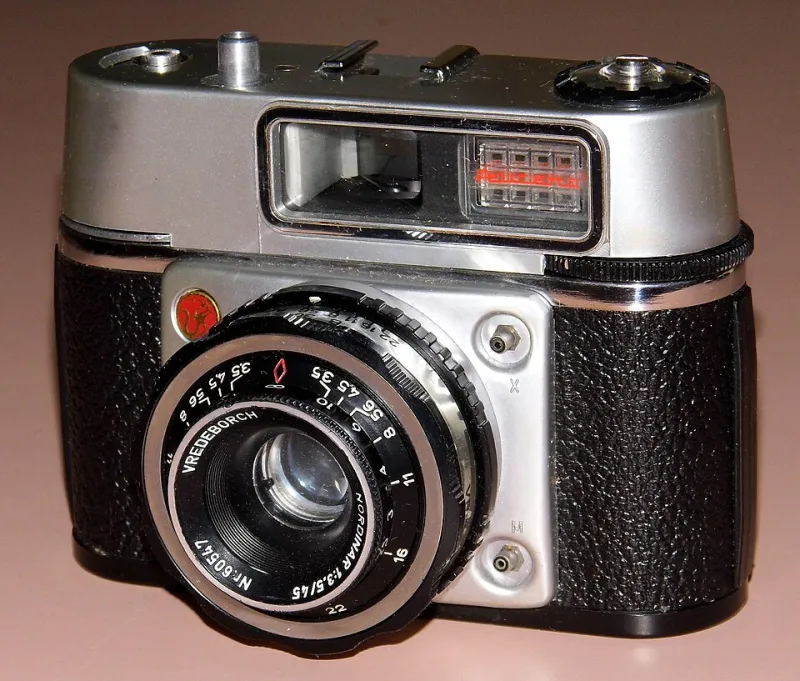
Photo: Joe Haupt from USA, CC BY-SA 2.0, via Wikimedia Commons
Here's something that tends to stop photographers mid-conversation: a battered Olympus OM-1 from 1973 can sync a flash at speeds that make plenty of modern mirrorless cameras look sluggish. Not because the old camera is somehow magical. Because the engineers who built it were solving a completely different problem — and the solution they landed on has aged remarkably well.
If you've ever wondered why your vintage 35mm body has a little lightning bolt symbol sitting at 1/125th or even 1/250th on the shutter speed dial, you're looking at one of the quiet superpowers of the film era. Let's dig into what's actually going on.
What Flash Sync Even Means (And Why It Matters)
When a flash fires, it dumps its entire burst of light in an incredibly short window — often somewhere between 1/1000th and 1/10,000th of a second. For that light to actually expose your film evenly, the shutter has to be fully open at the exact moment the flash fires. If the shutter is only partially open — one curtain chasing the other across the frame — you end up with a dark band cutting through your image. That's the dreaded sync failure, and it ruins shots in ways that are obvious and unfixable.
The maximum flash sync speed is simply the fastest shutter speed at which the shutter is completely open long enough for the flash to do its job. Push past that speed and you're asking for trouble.
The Mechanical Advantage of Leaf Shutters
Here's where vintage cameras start pulling ahead. A lot of classic 35mm cameras — particularly rangefinders like the Canonet QL17, the Yashica Electro 35, and various Voigtländer models — use what's called a leaf shutter. This is a set of overlapping metal blades built directly into the lens, and the way they operate is fundamentally different from the focal plane shutters found in most SLRs and virtually all modern digital cameras.
A leaf shutter opens from the center outward, reaches full aperture, then closes again. Because the entire aperture opens simultaneously, the shutter is fully open at every speed it operates. That means flash sync works at any shutter speed the camera offers — including the maximum. On a Canonet QL17, that's 1/500th of a second. On some medium format leaf shutter lenses, you can sync flash all the way to 1/500th without breaking a sweat.
Compare that to your average digital mirrorless body, where flash sync is often capped at 1/200th or 1/250th, and you start to see the gap.
Focal Plane Shutters: The Trade-Off That Stuck Around
Most SLRs — film or digital — use a focal plane shutter. Two curtains travel across the film plane in sequence. At slower speeds, the first curtain fully crosses before the second starts chasing it. At higher speeds, the second curtain starts moving before the first has finished, creating a traveling slit of exposure that scans across the frame.
That traveling slit is the problem. If the flash fires while the slit is moving, only part of the frame gets lit. So the flash sync speed on a focal plane shutter camera is limited by how fast the curtains can travel while still allowing a fully open moment.
This is where the vintage mechanical shutters genuinely shine. Camera engineers in the 1960s and 70s were building curtains from metal — thin, rigid, fast-moving titanium or aluminum foil. The Nikon FM2, released in 1982, famously achieved a 1/250th sync speed with its titanium shutter. The later FM2n pushed that to 1/250th as well, and the FE2 matched it. These were considered extraordinary engineering achievements at the time.
Modern digital cameras, meanwhile, have largely plateaued around 1/200th to 1/250th for mechanical shutter sync — and some have actually gotten worse. Why? Because digital sensors and the electronics surrounding them add complexity that mechanical engineers didn't have to contend with. The shutter assembly has to coexist with a sensor, a mirror box (in DSLRs), autofocus systems, and image stabilization hardware. Every millimeter of space matters, and that affects curtain design.
High-Speed Sync: The Workaround That Isn't Really a Win
Modern camera systems offer High-Speed Sync (HSS) as a way to use flash at shutter speeds beyond the mechanical sync limit. It sounds like a solution, but it comes with a real cost: HSS works by pulsing the flash rapidly as the slit travels across the sensor, effectively turning a single flash burst into a strobing effect. The result is that your flash loses significant power — sometimes two or three stops' worth — because instead of one full dump of light, you're getting a series of weaker pulses.
On a leaf shutter camera syncing at 1/500th, you get full flash power. Every time. No tricks, no power penalties. That's a meaningful difference when you're trying to overpower harsh midday sun for a portrait session or freeze motion on a bright outdoor shoot.
How to Use This Knowledge on Your Next Shoot
If you're shooting film with a rangefinder or a camera with a leaf shutter lens, start treating your sync speed as an asset rather than a limitation. On a bright day, sync at 1/500th and dial your aperture down to control ambient exposure while your flash handles fill light. You get clean shadows, punchy color, and none of the HSS power loss that would plague a digital shooter trying to achieve the same look.
For SLR shooters with focal plane shutters, knowing your camera's exact sync speed matters more than most guides let on. Check your manual — or look it up on Camera-wiki.org if you picked up a body without documentation. Some cameras have X-sync at 1/60th, others at 1/125th or 1/250th. Shooting below that threshold isn't a failure; it's just using your gear correctly.
If you're mixing flash with ambient light on film, that sync speed ceiling determines how much control you have over the background exposure. A camera with a 1/250th sync gives you significantly more creative room than one locked at 1/60th.
The Real Lesson Here
Vintage cameras didn't get everything right — nobody's arguing that a 1970s SLR beats a modern digital body in autofocus speed or low-light performance. But flash sync is one area where the engineering of the film era reflects a clarity of purpose that modern camera design has complicated rather than improved.
When you pick up a Canonet, an Olympus 35 SP, or even a well-maintained Nikon FM2, you're holding a machine that was built to sync flash efficiently — and it still does exactly that, fifty years later. That's not nostalgia talking. That's physics.
Know your shutter. Know your sync. Then go light something up.